MONEY & MEASUREMENT
Counting Coins and Making Change: Money Math That Sticks
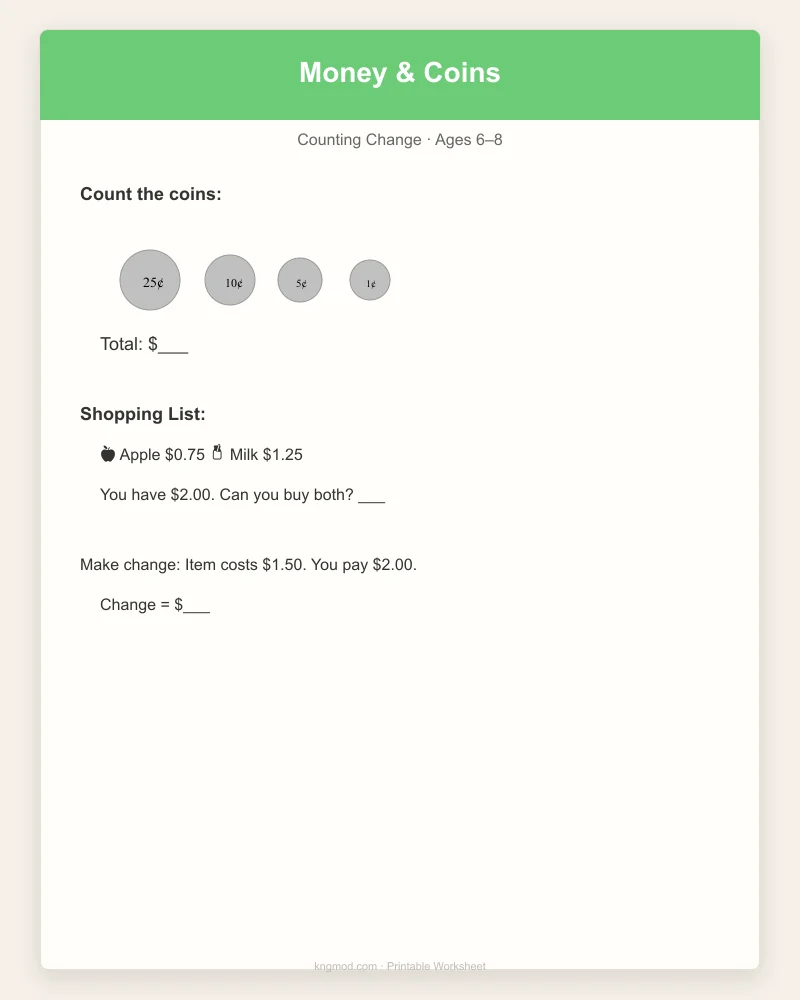
Money is the most useful arithmetic a young child will ever practise, because it has an obvious purpose and a built-in reason to get the answer right. It is also unusually tricky, because the coins in most currencies are designed for handling, not for teaching: the smallest coin is rarely the least valuable, the values jump in awkward steps, and the written amount uses a decimal point that many children have not yet met formally.
The sequence below keeps the coins real for as long as possible, adds writing only when the counting is secure, and ends in a game that practices the one money skill adults actually use daily—working out change.
Real coins before any worksheet
Start with an actual handful of coins and no paper at all. Ask the child to sort them into groups, then to line up all the coins of one value. Sorting is where recognition begins, and recognition must come before counting. A child who is still identifying which coin is which cannot be asked to add them up.
Name each coin by its value while the child handles it: “This is the five. This is the ten.” Handle them, stack them, count how many of each. Two short sessions of this, with no writing, do more than a page of coin-matching exercises, because the child is building a physical memory of the objects that will carry the numbers later.
Talk about the size trap early
Almost every currency contains at least one coin that breaks the “bigger means more” assumption, and children lean on size heavily in the early weeks. Say it directly: the coin’s size tells you nothing about its value; you have to look at what is printed on it. Then let the child find a small coin worth more than a larger one and say the values out loud. Catching this expectation early saves a lot of reversed answers later.
Count a mixed pile by starting with the largest
Given a pile with several values, the reliable method is to order the coins from largest to smallest and then count on. Put the biggest coin first and name its value, then add each coin in turn, counting on from what you already have. This habit—biggest first, count on—prevents the common failure where a child adds a small coin and then loses track of the running total.
It also connects directly to skip counting. A handful of five-value coins is counted in fives, ten-value coins in tens, and the child who is already fluent at counting by fives and tens will find mixed coin piles far easier than one who is not.
Make exact amounts, then make them again
Set a target, such as a price label reading 42, and ask the child to build it with coins. The interesting part is asking for a second solution afterwards: can you make 42 a different way? Finding two routes to the same total strengthens the idea that a value can be represented in many ways—which is really the beginning of flexible thinking about number. It also quietly introduces the idea that some solutions use fewer coins, which is the everyday skill of paying efficiently.
The Counting Coins pack includes both counting and exact-amount tasks so this back-and-forth between totalling and building can happen on paper once the physical version is comfortable.
Making change: count up, do not subtract
Making change is where money practice earns its keep, and it is best taught as counting up rather than subtracting. If something costs 35 and the customer hands over 50, the child starts at 35 and counts up to 50, noting the coins used along the way: 5 more gets to 40, 10 more gets to 50, so the change is 15. Subtraction would give the same answer, but counting up matches what a person actually does in a shop and is far less error-prone for a child who is still shaky with borrowing.
Practise it with real coins and a price label. The child takes the coins for the item, you hand them a larger coin, and they return the change counting upwards. Once that is fluent, the written version on paper is simply a record of something the child already knows how to do.
The written form can wait a little
Writing amounts with a decimal point mixes money with decimal notation, and a child who has not yet met decimals formally will often misread 2.50 as two hundred and fifty. Keep to spoken amounts and coin values until the counting and change-making are reliable. When decimals do arrive, the child already has a concrete meaning for the two digits after the point, and the notation becomes a shorthand rather than a new mystery.
A shop game that actually practices the skill
Take a few household items, write price labels, and open a shop at the kitchen table. One person is the shopkeeper, the other the customer, then swap. The shopkeeper must work out the total when two items are bought together, and the change when a larger coin is handed over. Two items is enough at first; three is a good stretch a week later.
Because the customer and shopkeeper roles alternate, the child practices both directions of the arithmetic—adding prices together, and counting change back up. It also gives the numbers a reason, which is what stops the practice feeling like a worksheet with coins drawn on it.
Where to fit money into the week
One counting session and one shop game per week is plenty for most children, with the everyday bonus of handling real coins when a small purchase is made. Keep the coins in a tin and use them for other arithmetic too: the addition and subtraction practice a child does on paper becomes more meaningful once they have added real values and counted real change.
Money is also a gentle introduction to place value in a new unit, since cents and units behave like ones and tens in a different costume. A child who is confident counting coins, building exact amounts and counting change upwards has learned several of the ideas that later mathematics will keep asking them to reuse.