NUMBER SENSE
Why Place Value Fixes Teen-Number Confusion
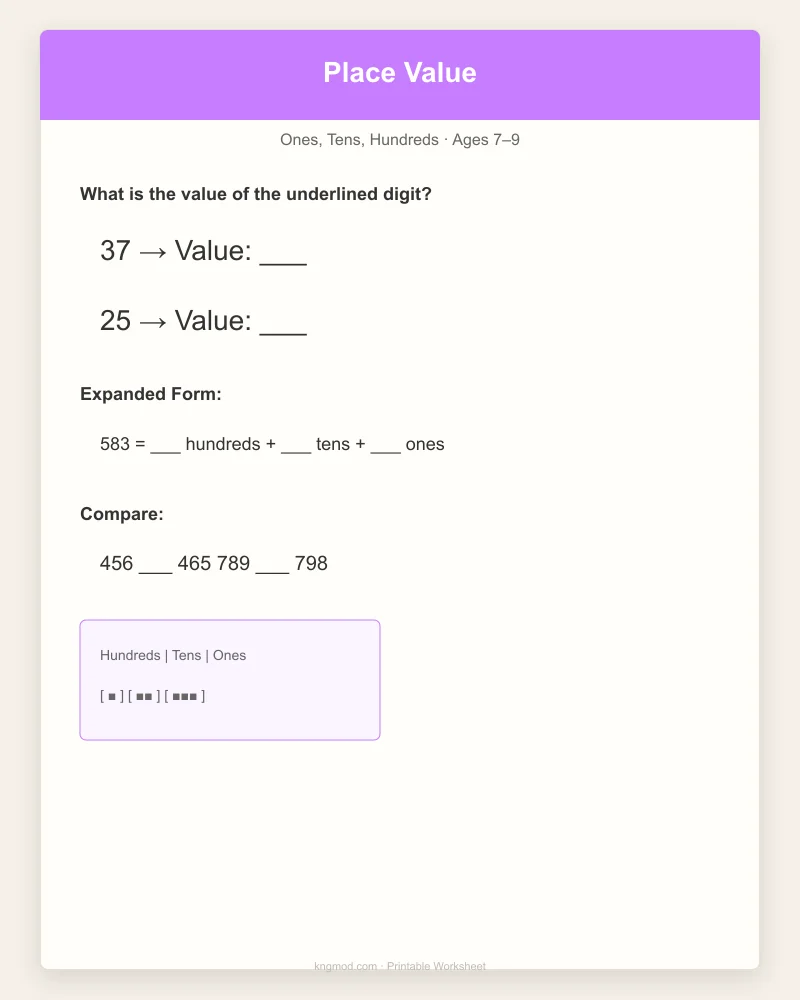
A child writes 41 for fourteen. Or counts on their fingers, quietly, to work out that four plus ten is fourteen. Or looks blank at “thirteen minus three” and then answers fifteen. These are not three separate problems. They are almost always the same problem wearing different clothes: the child has learned the names of numbers without learning that a two-digit number is a statement about tens and ones.
English number names work against us
In many languages, fourteen is said as “ten-four”. The name tells you the composition. English does the opposite for the whole teens: eleven, twelve, thirteen, fifteen—the names give almost no clue about the digits, and the ones that do (“four-teen”) put the smaller number first while the written form puts it last. Then the twenties switch pattern entirely: twenty-one is said in the same order it is written. No wonder children mix them up.
The practical consequence is that a child can be perfectly fluent counting out loud from ten to twenty and still have no reliable idea of what the written numerals 14 and 41 mean. Sound and symbol have been learned separately, and nothing has connected them.
Make ten something you can hold
Place value needs a physical ten before it needs a symbol. Straws are ideal: bundle ten of them with an elastic band and keep the loose ones beside the bundle. Now the number fourteen is not a word to memorise; it is one bundle and four loose straws. Ask the child to build 14, then 41, and put the two side by side. Both use five straws. Both are made of one group of ten and four singles. Only the arrangement differs—and that difference is the entire reason 14 and 41 are different numbers.
This side-by-side comparison of 14 and 41 is worth repeating with several pairs: 16 and 61, 17 and 71, 19 and 91. Use the same materials each time so the child is comparing the arrangement, not learning a new object.
Say the number name as a sentence
Replace the name with a description whenever a teen appears. Fourteen becomes “ten and four more”. Fifteen becomes “ten and five more”. The child hears the composition every time, and the written form starts to look like what it says. After a week or two of this, the standard name can return on its own, because the child now has something for the name to attach to.
The Place Value Power pack is built for exactly this work: tens-and-ones activities that keep returning to the bundle-and-singles picture before asking a child to work with the abstract digits.
The -teen and -ty trap
Once the teens are steadier, a new confusion usually appears: thirteen against thirty, fourteen against forty, fifteen against fifty. In speech these are nearly identical, which makes them a listening problem as much as a number problem. Fourteen ends in a softer sound; forty ends in a longer, heavier one. Many children genuinely cannot hear the difference, and they answer whichever they happened to think of first.
Writing both numbers down while you say them slowly helps more than repeating your pronunciation. Point at 14 and say “ten and four”; point at 40 and say “four tens”. The written digits are doing the disambiguating work that the spoken words cannot.
Ten-frames and number lines
A ten-frame—two rows of five boxes—makes ten visible in a way a bundle of straws cannot, because it shows how far the number has travelled past ten. Fourteen fills one frame and four boxes in the next. A number line from 10 to 20 shows the same thing as distance. Children who struggle to name numbers past 13 often count faster and more accurately when they can track the position with a finger on a line than when they are answering from memory alone.
Both tools are cheap and printable, and both do the same job: they keep the quantity visible while the name is still uncertain.
What to do when the mistake happens
Do not correct the digit; ask the child to build it. When a child writes 41 for fourteen, hand them the straws and ask them to show you fourteen. The mismatch between the number they build and the number they wrote becomes visible to the child, which is far more useful than an adult pointing at the digit and saying “wrong way round”. The way we sort mistake types applies here too: a reversal is usually a meaning gap, not a slip, and it needs a different response from a careless copy.
Why this matters beyond the teens
Every later skill leans on place value. Regrouping in addition, borrowing in subtraction, the structure of multiplication, the decimal point—each one is a restatement of tens and ones for smaller or larger units. A child who reaches fourteen confidently arrives at double-digit addition with something to build on. A child who is still guessing at fourteen will find double-digit arithmetic mysteriously difficult for reasons that have nothing to do with the arithmetic itself.
So it is worth the detour. Two weeks spent on bundles, ten-frames and “ten and four more” tends to save months of puzzled corrections later, and it gives the child a genuine explanation to offer when someone asks them how they know.