ADDITION & SUBTRACTION
Teaching Addition with Regrouping, Step by Step
Regrouping is the point in elementary arithmetic where a lot of children quietly stop understanding the work and start performing it. They learn the phrase “carry the one”, write a small 1 above the tens column, and produce correct answers for a while. Then a page appears with three digits, or with a zero in the ones column, or with a subtraction underneath it—and the trick collapses because it was never a rule they could reason with.
The good news is that regrouping is one of the easiest ideas to teach properly. It is simply a trade: ten ones in one place can be exchanged for one ten in the next place, and the total does not change. Everything below is a way of making that sentence visible to a child before asking them to write it as a symbol.
Start with the trade, not the digits
Before any worksheet, give the child loose ones and rods, or a pile of straws with an elastic band. Ask them to make 27 out of the materials: two bundles of ten, seven loose ones. Now ask for eight more loose ones, added to the pile. The count goes past ten, which is exactly where the interesting part begins. Nine, ten—and now there is a bundle waiting to happen.
Let the child tie or trade ten of the loose ones into a new ten. Nothing has been added and nothing thrown away; the pile looks different, the value is the same. Say the sentence out loud: “Seven ones and eight ones made fifteen ones. Fifteen ones is one ten and five ones. So we trade ten of them for a new bundle.” That sentence is the whole skill, and it is worth repeating for a week without ever writing a number.
Do the same trade starting from 27 + 3 first, where the numbers are friendly and the result is a clean 30. Comfortable trades build the habit before the answer gets untidy. Only after that move on to something like 27 + 8.
Choose one word and keep it
Children who hear “carry”, “borrow”, “regroup”, “rename”, “trade” and “exchange” within the same month are being asked to map five labels onto an idea they have only just met. Pick one—regrouping is the word most curricula use—and use it consistently at home. If the school uses a different word, still explain both once, then settle on one for your own practice sessions.
Keep “carry” out of the vocabulary if you can. To a child, carrying means holding a thing and walking with it; it gives no clue that a value is changing place. “Regrouping” at least contains a hint of the reorganising that is actually happening.
Expanded form is the bridge worth slowing down for
When the materials are understood, write the same problem in a stretched-out form before using the compact column method. For 27 + 8, write 20 + 7 + 8 along a line. The child already knows seven plus eight is fifteen, so the line becomes 20 + 15. Now it reads as 20 + 10 + 5, which is 35. No mysterious 1 floats above a column; the ten is visible as a ten.
This step is where the strongest understanding usually forms, and it is also the step adults skip because it feels slow. Give it several sessions. The goal is not speed here. It is that when the child later sees the small 1 written above the tens column, they recognise it as that same ten from the expanded line.
This step is where the strongest understanding usually forms, and it is also the step adults skip because it feels slow. Give it several sessions. The goal is not speed here. It is that when the child later sees the small 1 written above the tens column, they recognise it as that same ten from the expanded line.
Then let the written method earn its place
Only after the expanded form is comfortable should the compact column layout take over. Show that the two forms are the same calculation written differently, not a new rule. Write both side by side for a few problems: the expanded line on the left, the column on the right, same answer at the bottom of each.
Once the child trusts the connection, the small 1 above the tens column stops being a decorative mark. It is a record of the ten they just traded, and they can explain it if asked. That explanation is the real test of whether the skill has landed—not a page of correct answers.
Two traps that look like carelessness
The first trap is the column that ends at exactly ten. For 36 + 4, the ones column gives ten, so the child trades all of it and writes 0 in the ones place before adding the new ten. Many children leave that space blank or copied from the number above, and the answer drifts. Practising a few problems where the ones column makes exactly ten, deliberately, prevents the confusion later.
The second trap is adding the regrouped ten but forgetting it in the next column, or adding it twice. Rather than pointing at the mistake, ask the child to narrate the trade: “What happened to the ten here? Where did it go?” Nine times out of ten they will find it themselves, and the correction sticks better than a circled error.
If you want a systematic way to decide what a page of errors is actually telling you, our note on using mistakes to plan the next activity walks through sorting slips, strategy gaps and meaning gaps—useful when a whole page of regrouping looks wrong for one underlying reason.
Choosing pages that fit this sequence
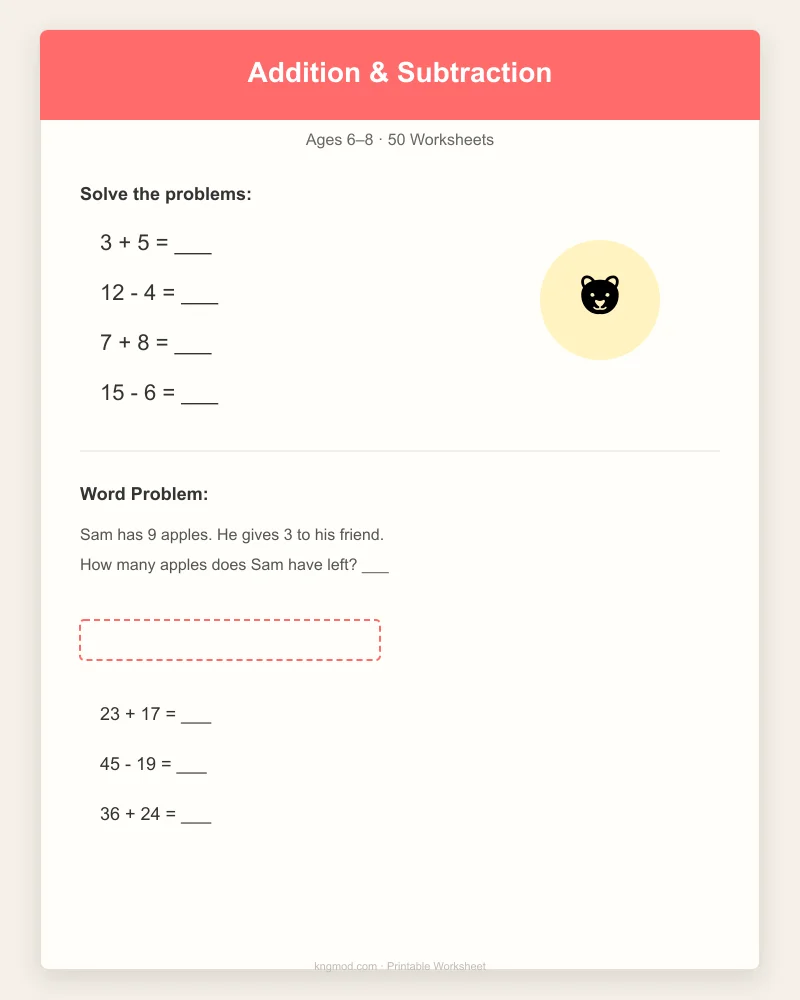
A good regrouping pack starts easy on purpose. Look for early pages limited to single-digit facts, so the child settles into the format before carrying appears, then a gradual move into double-digit sums with one regrouped ten. The Addition & Subtraction Fun Pack is laid out this way: ten printable pages that begin with facts a child can finish comfortably and only later ask for a trade. An answer key is included, and it is worth using the way we describe in our note on answer keys—asking the child to explain one corrected problem rather than simply marking the page.
If the underlying trouble is not the trade but the idea of tens and ones themselves, work on that separately first. The Place Value Power pack builds the tens-and-ones language that regrouping depends on, and it pairs naturally with the second layer of this sequence.
A ten-minute regrouping session
Three or four trades with materials, two problems in expanded form, then one or two in the column layout. Stop while the last answer was still confident. That is a complete session, and it is short on purpose: regrouping is thinking-heavy work, and a child who is still explaining “where the ten went” is doing more than a child racing through twenty silent sums.
Keep the page in front of you rather than in a folder. A single sheet used twice across a week, with a short conversation in between, usually teaches more than three fresh pages used once each. When the written method starts to feel routine and the child can explain the trade without prompting, you are ready for the next stage—the same idea with larger numbers, which is exactly what readiness for double-digit addition is really asking about.