MEASUREMENT & TIME
Teaching Kids to Tell Time: A Realistic Sequence
Telling the time is unusual among early math skills because so much of it is a naming exercise. The child is not calculating anything; they are reading an instrument that uses two hands, twelve numbers, and a vocabulary that includes phrases like “twenty to six”. Add the fact that the number the minute hand points at has nothing to do with the number of minutes, and it is easy to see why the clock takes longer to learn than adults expect.
The sequence below is the order that tends to work in practice. Each step assumes the previous one is solid, and the whole thing is spread across weeks rather than concentrated into one. Rushing ahead usually produces a child who can read o'clock times and half past but falls apart at 7:45.
Before any of it: does the child need the time yet?
Time-telling lands far better with a child who actually wants to know the answer. If bedtime is at eight and the child keeps asking how long until then, the clock has a purpose. If it has no purpose, the numbers are an abstract drill with a slow payoff. A simple routine—write the time on a sticky note, or ask the child to check the clock before a favourite programme—creates the reason to read it.
Step 1: The hour hand alone
Cover the minute hand with a strip of paper or a small sticker, and read only the hour hand. The child just needs to say which number the short hand is closest to. Nine o'clock, three o'clock, seven o'clock. Do this for several days with a real clock, moving the hands yourself or using a wooden teaching clock, until it is effortless.
The one case worth practising deliberately is when the hour hand sits between two numbers. At half past nine, the hour hand is nearly halfway to ten, and children who have learned “read the number the hand is nearest” will say ten. Show them that this hand is still travelling towards ten; it has not arrived yet. The rule “the hour hand is between the number we have passed and the next one” is worth stating explicitly, because it prevents a mistake that reappears for months otherwise.
Step 2: Half past, then o'clock and half past together
Bring the minute hand back and introduce the two positions that carry the least vocabulary: pointing straight up is o'clock, pointing straight down is half past. No counting is required yet, only position. Practise reading and setting a mix of the two until the child can move between them without hesitating.
Half past is a good first laboured concept because it lets you talk about the journey round the clock. The minute hand has travelled half of the way, and the hour hand has travelled half of the way to the next number as well. That observation is what makes “half past nine” make sense rather than simply being a phrase to remember.
Step 3: Counting in fives around the face
Before the child reads a five-minute time, they need to be able to count round the face in fives, pointing at each number in turn. This is skip counting applied to a dial, and it is why fluency in counting by fives pays off twice—once in multiplication, once at the clock. Marking the numbers 5, 10, 15 and so on around a paper clock face makes the connection visible.
Only after that counting is smooth does the minute hand get its full meaning. When the long hand points at the 3, it has passed 5, 10, 15—so it is quarter past. The number 3 on the dial and the number 15 in the time are two different things, and children need that difference said out loud rather than left to be inferred.
Step 4: Quarter past and quarter to
Quarter past is straightforward—fifteen minutes past the hour, minute hand on the 3. Quarter to is the awkward one, because the reading runs backwards from the next hour. At quarter to nine, the minute hand points at the 9, yet the hour about to arrive is nine. The child has to read a position, connect it to fifteen minutes, and then subtract those fifteen minutes from the coming hour.
Keep “quarter to” out of the rotation until the five-minute counting is secure, and when you introduce it, always say both versions once: “quarter to nine—that is the same as eight forty-five.” Hearing the two readings side by side builds the bridge. Many adults still translate “quarter to” into the digital time internally; expecting a child to do it instantly is unreasonable.
Step 5: Any five-minute time, then any minute
With the quarters in place, widen to all the five-minute marks: ten past, twenty past, twenty-five past, and the corresponding “to” times. Reading a specific five-minute time aloud—say, 4:35—should become routine before you introduce individual minutes. Individual minutes multiply the counting load, and most daily purposes do not need them until later.
When you do reach single minutes, the same structure holds: count by fives to the nearest mark, then count on one at a time. Reassure the child that “6:07” is not a harder kind of time, just a more precise one.
Digital and analogue together
Children today meet digital clocks constantly, and there is no reason to hide them. In fact, showing both simultaneously helps: the child sees 7:45 on the digital display while reading “quarter to eight” from the analogue one, and the two readings learn to travel together. What causes trouble is learning only one format. A child who can read a digital clock but not an analogue one will eventually need the analogue for the everyday phrases that surround time.
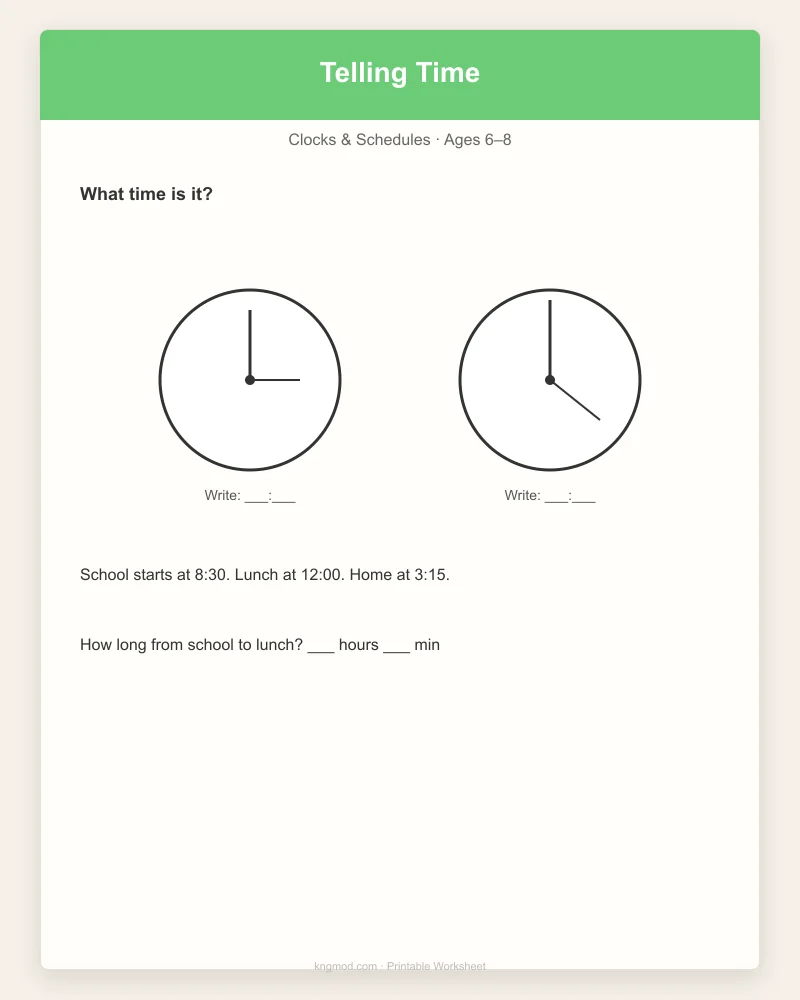
The Telling Time Workbook includes both analogue and digital practice, which makes it easy to follow the sequence above on paper after the child has worked with a real clock. Short daily sessions beat a long weekend session here as everywhere else.
Keeping it practical
Tie each new step to a real event in the child’s day. O'clock, then half past, then quarter past and quarter to, each attached to something that happens at that time in your household. A clock that maps onto the child’s own routine is remembered; a clock that only exists on a worksheet page is not.
And keep the sessions short. Five minutes of reading the time before breakfast, every day, will move a child further in a month than an hour of clock worksheets on a rainy afternoon. If the child starts guessing rather than reading, stop—the daily habit will pick it up tomorrow.