MULTIPLICATION
From Skip Counting to Multiplication: Building the Bridge
Ask a child who is struggling with the six times table to skip count in sixes and something interesting happens. Often they can do it—haltingly, but correctly. They can count 6, 12, 18, 24 out loud, yet they cannot answer “six times four” without starting from six. The sequence lives in their mouth, not in their thinking. Multiplication is what happens when that sequence is connected to groups, and the gap between the two is where most of the early trouble sits.
This article is about building that bridge in order: rhythm first, groups next, arrays third, and the abstract facts last. Reversing the order is the single most common mistake, and it produces children who can recite a table and still freeze when the numbers appear in an unfamiliar format.
Skip counting is a rhythm before it is a strategy
Start with counting in twos, fives and tens, out loud and with the fingers or a number line to point at. The aim at this stage is fluency of sound, not written answers. Counting in fives has a natural beat; tens are close to free once place value is in place; twos are the easiest to hear because every second number is a familiar even. Let the child chant these while walking upstairs, setting the table, or waiting at a red light.
Do not rush past this. A child who is genuinely fluent in counting by twos, fives and tens has, without knowing it, already learned a large part of the two, five and ten times tables. That is a substantial head start, and it costs only a few minutes at a time.
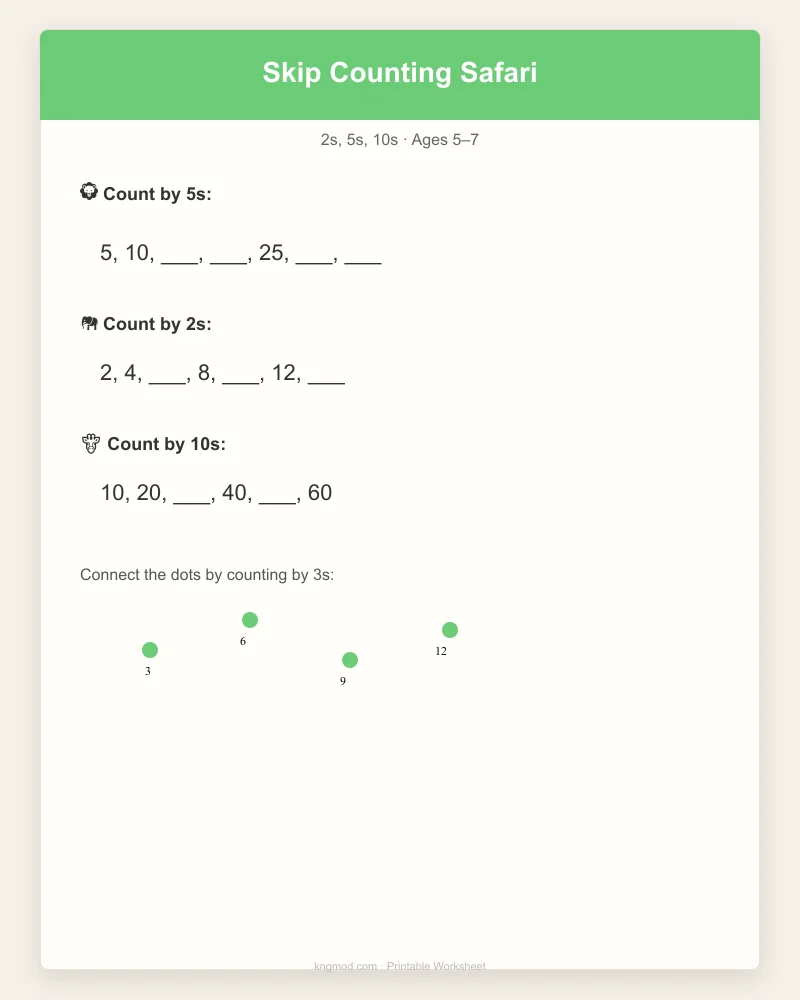
The Skip Counting Safari pack was built for this stage: pages that move through twos, fives and tens with enough repetition to build the rhythm without turning it into a written drill the child is not ready for.
Then attach the rhythm to groups
Once counting by fives is smooth, put five counters in front of the child and ask them to make three groups of five. Count the total by fives as they build. Now say the sentence twice: “Three groups of five is fifteen. Three times five is fifteen.” Same picture, two ways of saying it. The word “times” arrives attached to something the child can see, which is exactly what it should be attached to.
Repeat this with a handful of small numbers before writing anything. The child should be able to go both ways: given three groups of five, find the total; given a total of fifteen, make equal groups that fit. That second direction—finding the groups from the total—is quietly the beginning of division, and it is worth a few minutes on its own.
Arrays make the structure visible
An array is simply a rectangle of dots or counters: three rows of five, four columns of six. It is the single most useful picture in early multiplication because it shows several things at once. The child can count in rows, count in columns, and see that both counts reach the same total. That is why three times five and five times three give the same answer—not as a rule to memorise, but as a rectangle to look at.
Turn an array a quarter turn and the rows become columns. Nothing has been added or removed, so the total cannot have changed. Children find this genuinely satisfying, and it halves the number of facts they think they need to learn. Four rows of six is the same rectangle as six rows of four, so knowing one gives the other.
Turn an array a quarter turn and the rows become columns. Nothing has been added or removed, so the total cannot have changed. Children find this genuinely satisfying, and it halves the number of facts they think they need to learn. Four rows of six is the same rectangle as six rows of four, so knowing one gives the other.
Use known facts to reach unknown ones
Once a few facts are secure, teach the child to build the ones they do not know from the ones they do. If five times six is thirty, then six times six is thirty plus one more six—thirty-six. If ten times seven is seventy, then nine times seven is one group of seven fewer, which is sixty-three. This is where skip counting pays off directly: the child is not guessing, they are extending a pattern by one more or one less group.
The hard band in the tables is almost always sixes, sevens and eights. Those facts contain few easy patterns and arrive in the middle of the more comfortable fives and tens. Rather than drilling them in isolation, connect them: eight times seven is close to ten times seven, minus two groups of seven. That route is slower than recall and much faster than staring at a blank page.
The Multiplication Mastery Sheets pack is organised so a child practices one small band at a time and returns to it after a break, which is how the harder facts usually settle. Answer keys are included, best used the way we describe in our article on answer keys—to find which band is weak, not simply to score the page.
Only now time the facts
Speed has a place, and it is at the end of this sequence. A child who understands arrays and can extend a fact by one more group is ready to work towards quick recall. A child who has been timed too early learns something different—that multiplication is a memory test with a clock attached—and reaches for whatever strategy is fastest, which is often counting on fingers or guessing.
Our note on why multiplication speed drills should come after understanding goes into this in more detail, including how to tell the difference between a fact that has been retrieved and a fact that has been counted on silently.
Where a reference sheet helps, and where it does not
A multiplication grid on the wall is genuinely useful—for checking, for spotting patterns, and for the diagonal of square numbers that children like to notice. A multiplication table poster works well above a desk where a child can glance at it while thinking. The caveat is that it should be a checking tool, not a replacement for the rhythm and the arrays. If a child reaches for the grid every single time without pausing to think, the underlying facts have not yet been built.
A short session that covers the whole bridge
Two minutes counting in the target number out loud, three minutes building equal groups and drawing one array, then four or five written facts using the pattern the child just built. Finish with one fact from an earlier number, to keep it warm. That is a complete session, and it takes about ten minutes.
Run it two or three times a week rather than every day. Multiplication facts settle well with short, spaced repetition, and a child who met the same structure five times across a fortnight will usually recall it more reliably than one who drilled it for forty minutes on a Sunday and forgot it by Wednesday.